Reflective and Low-E glass are often discussed as competing options, but they solve different parts of the same problem. One controls how the facade looks and how much solar radiation is reflected; the other controls how much heat radiates through the glass. Many projects benefit from both.
How reflective coatings work
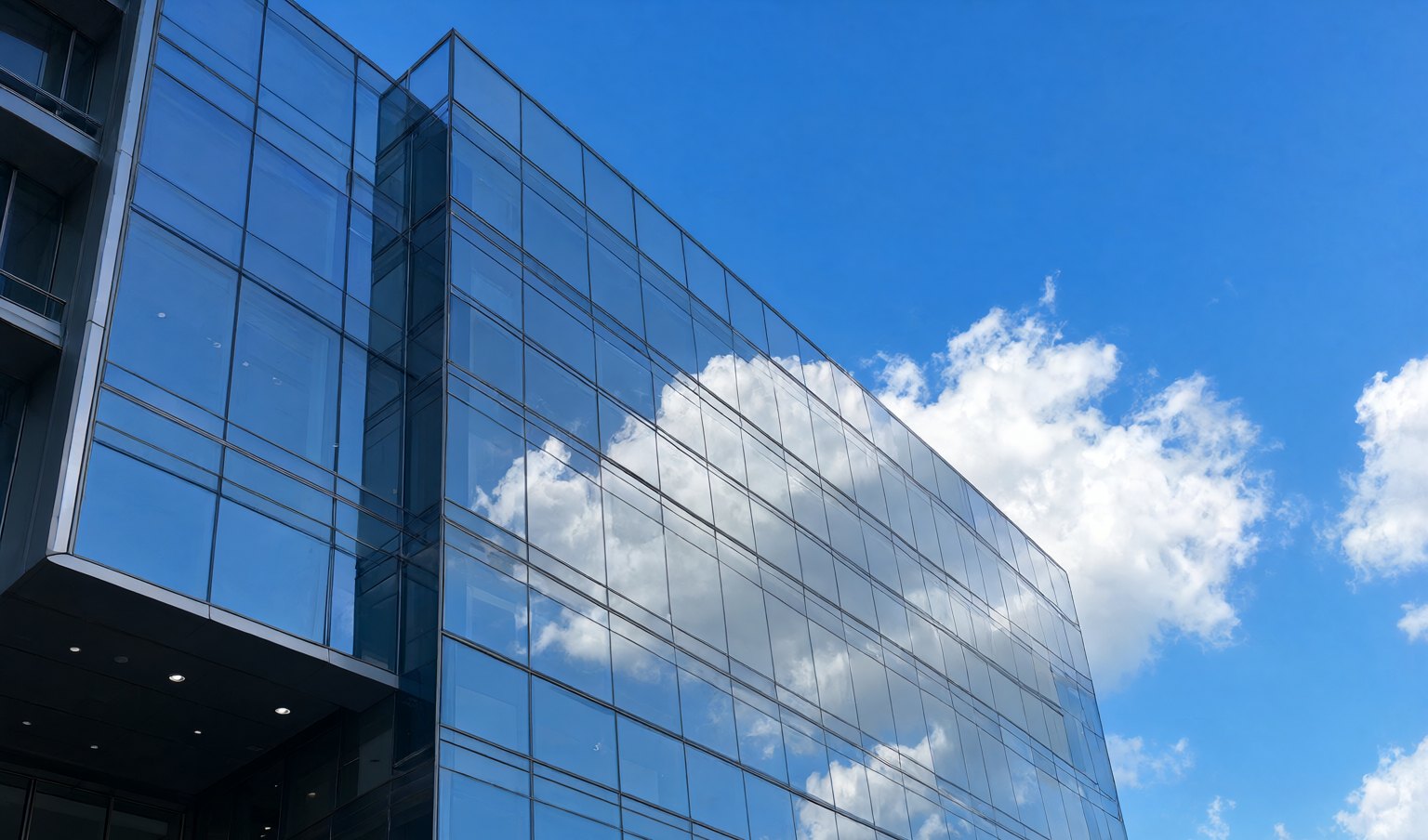
A reflective coating is a thin metallic layer that reflects a significant part of the solar spectrum. It reduces solar heat gain and creates a mirror-like appearance. The strength of the effect depends on the coating, the glass tint and the lighting. Reflective glass can give a building a crisp, uniform facade, but it can also create strong reflections that affect neighbouring buildings or views.
How low-E coatings work
A low-E coating is designed to reflect long-wave infrared radiation while allowing visible light to pass. In an insulated unit, it reduces heat transfer between the interior and exterior. Low-E glass usually looks more neutral than reflective glass, which makes it a common choice where the design wants clear views and a less mirrored appearance.
Appearance and context
Reflective glass reads as a mirror from many angles, especially when the exterior is brighter than the interior. That can be an advantage for privacy and a uniform facade, but it can also make the building look dark at night. Low-E glass is subtler, although some coatings still produce a noticeable colour or reflection. A physical sample viewed against the sky and against a dark interior is the best way to judge the effect.
Performance differences
- Reflective coatings are strong at reducing solar heat gain and glare.
- Low-E coatings are strong at reducing heat loss and controlling radiant heat flow.
- Both can be combined with tinted glass, laminated glass or insulated units.
- The final performance depends on the whole assembly, not the coating alone.
Orientation and glare
A west facade may need stronger solar control than a north facade, and a reflective coating can help with low-angle sun. However, the same coating may make the interior too dark on an overcast day or create glare for occupants. Review the orientation, the surrounding buildings and the interior programme before selecting a single coating for the whole envelope.
Night-time appearance
At night, the effect reverses: a reflective facade can look transparent from outside while the interior is lit. That may be desirable for retail or undesirable for residential privacy. Low-E units with interior blinds or a fritted pattern can provide a different balance.
Combining coatings
Some projects use a reflective coating on one face and a low-E coating on another, or combine a neutral low-E coating with a tinted substrate. These combinations can deliver the appearance and performance the design needs, but they must be reviewed as a system. The coating surface, cavity width and gas fill all change the result.
Selection checklist
- What appearance is required during the day and at night?
- How much solar heat gain and glare must be controlled?
- How much daylight should reach the interior?
- Are there neighbouring buildings or views affected by reflection?
- Does the project require a specific safety, acoustic or thermal build-up?
Casada supplies reflective, Low-E, tinted and laminated glass in made-to-order build-ups. Our team can compare coatings on a sample and review the full assembly so that the facade meets its appearance and performance targets together.
Need glass for a project?
Send your drawings and requirements for a practical, project-specific proposal.