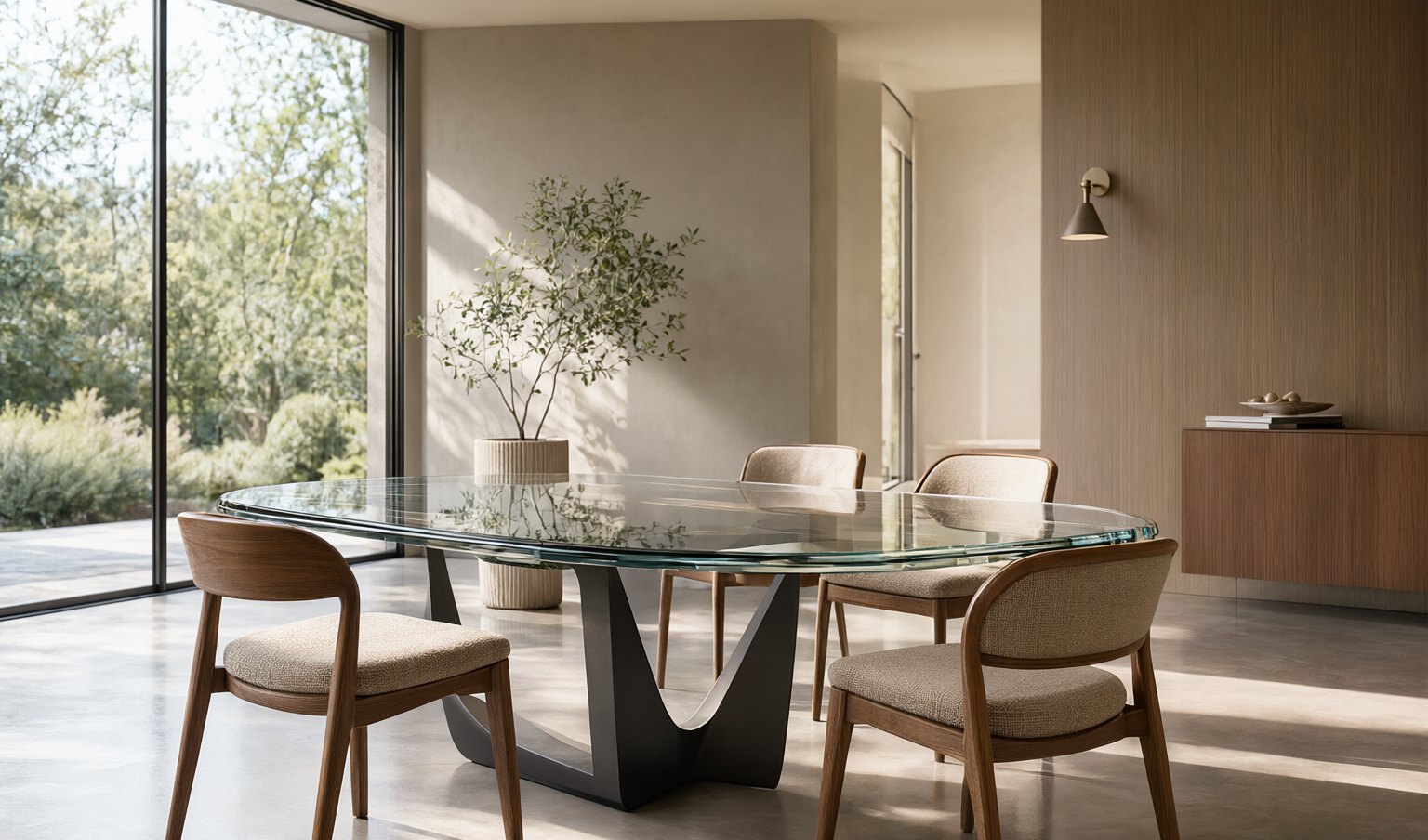
Glass furniture looks simple, but a table top or shelf is a structural element. Thickness, edgework, support and fittings all affect how the piece behaves when someone leans on it, moves it or places a heavy object on the surface.
Start with the support condition
Glass is strong in compression but brittle in tension, and it performs best when it is supported evenly. A top that rests on a continuous frame behaves differently from one held by four small points. Before choosing a thickness, define the support points, the free span and the loads the piece must carry. A furniture designer or structural engineer should confirm the arrangement for unusual shapes or long spans.
Thickness and tempering
Thicker glass is not automatically safer if the support is poor, but it does resist deflection and impact better. For tables, shelves and other furniture surfaces, tempered glass is normally specified because of its strength and safer break pattern. The glass should be cut, drilled and edgeworked before tempering, so the final hardware layout must be confirmed early.
Edge profiles
- Flat polish: a clean, straight edge for modern tables and shelves.
- Bevel: a angled edge that catches light and adds visual weight.
- Pencil polish: a rounded edge that is comfortable to touch.
- Arris: a lightly ground edge for concealed or low-cost applications.
The edge is where handling damage usually starts. A polished edge removes small flaws and reduces the chance of a chip developing into a crack.
Holes, fittings and hardware
Holes for legs, brackets or shelf supports need adequate edge distance and clean drilling. Metal fittings should not clamp the glass directly without a compliant gasket or sleeve. Thermal movement and vibration can loosen a fixing over time, so the design should allow for minor movement without creating a point load.
Safety film and break behaviour
Tempered glass breaks into small fragments, which reduces injury risk but can leave the surface unusable. For furniture in public spaces, schools or hospitality projects, a laminated build-up or a safety film can hold the fragments together after breakage. The choice depends on the application and the project's safety requirements.
Care and cleaning
Use a non-abrasive cleaner and a soft cloth. Avoid placing hot cookware directly on glass, and use coasters for items that could scratch the surface. Inspect edges and fixings periodically, especially on tables that are moved often.
What to send for a furniture quote
- Drawings or sketches with overall dimensions and support locations.
- Glass type, thickness, colour and edge profile.
- Hole positions, diameters and hardware details.
- Quantity, packing requirements and destination.
- Any safety film, lamination or matching requirements.
Casada produces made-to-order glass tables, TV stands and furniture components, with cutting, edging, drilling and tempering completed in house. Our team can review the support condition and hardware layout before production so that the finished piece matches both the design and the way it will be used.
Need glass for a project?
Send your drawings and requirements for a practical, project-specific proposal.