Glass can survive years of service and still fail in transit if packing is treated as an afterthought. Sea freight exposes a crate to vibration, humidity, repeated handling and changes in temperature. Good export packing controls those risks before the container doors close.
Packing starts with the order details
Crate design depends on panel size, weight, quantity and the route. A small order of cut-to-size pieces may travel in a compact crate with dividers, while large facade lites need a rack that keeps every sheet vertical and supported along its edges. The loading plan should be agreed early enough to match production and transport bookings.
Crate construction
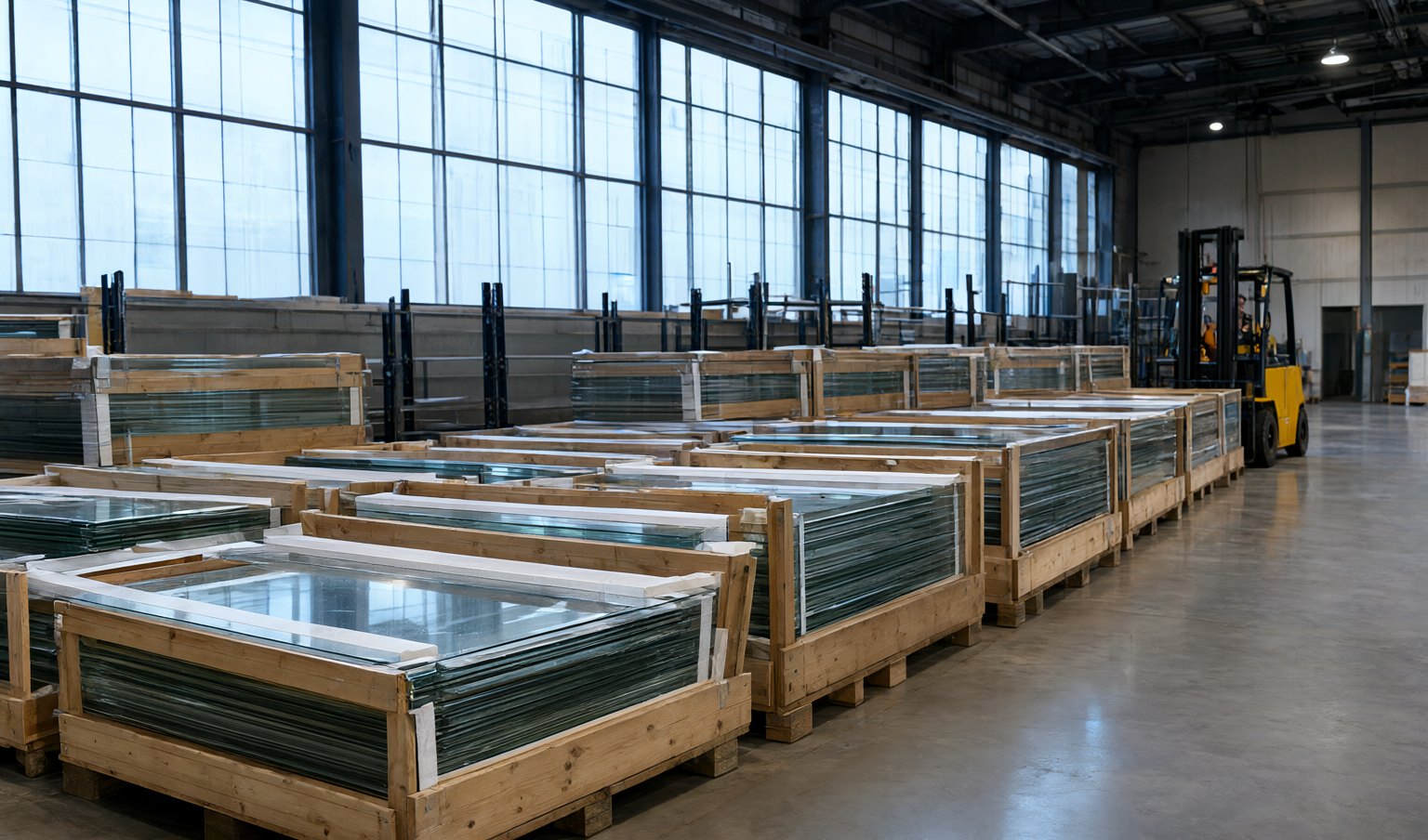
A sea-worthy crate needs a rigid base, strong vertical supports and enough bracing to resist racking during lifting and transport. Timber should be dry, free from large defects and treated where the destination requires it. Forklift pockets or lifting points are positioned so that the crate can be handled without putting pressure on the glass.
Internal surfaces that touch the glass are lined with soft, clean material. Fasteners and staples are kept away from the glass face, and any timber that could rub against an edge is covered or removed.
Separating and protecting edges
Glass should never touch another sheet directly. Interleaving paper, foam or cork separates the surfaces and absorbs small movements. Edge protectors or foam profiles cover the most vulnerable part of each panel, especially on polished or exposed edges. Corner protection prevents local impact damage during loading and unloading.
Panels are restrained so that they cannot slide, but the restraint should not clamp the glass face. Pressure on a small area can create a stress point that only appears when the crate is opened.
Controlling moisture
Sea freight can combine high humidity with large temperature swings. Moisture trapped inside a crate may condense on cooler glass surfaces and leave marks, haze or mould on interleaving paper. Desiccant, moisture-barrier wrapping and sensible ventilation help keep the internal environment stable. Crates should not be sealed while the glass or packing material is wet.
Loading and securing the container
Weight is distributed across the container floor and away from weak points. Crates are blocked and lashed so that they cannot move during transport, and the loading pattern leaves access for inspection where needed. The container itself should be checked for leaks, odours and contamination before loading.
Inspection before dispatch
Before the container is sealed, the packing team checks crate integrity, edge protection, labels and the packing list. Photographs of the loaded crate and container help resolve any transport question later. Export documents, including the packing list and commercial invoice, should match the physical shipment.
Receiving glass on site
Good packing cannot compensate for poor site handling. Crates should be lifted rather than dragged, stored upright on level ground and kept away from traffic and construction activity. Glass should be inspected before the delivery is signed, and any damage should be photographed while the packing is still in place.
Casada packs every export order in strong sea-worthy wooden crates with edge protection and clear labelling, and coordinates the packing plan with the production schedule. For projects with unusual sizes or a demanding route, our team can review the handling sequence with the customer before the order is released.
Need glass for a project?
Send your drawings and requirements for a practical, project-specific proposal.